We fix what is costing you sales
Not a checklist of busywork. We find the two or three things actually keeping your products off page one, and we start there. If your title tags are fine, we will not bill you to rewrite them.
Shopify & Shopify Plus SEO Agency · Canada
We provide Shopify SEO services for Shopify and Shopify Plus stores. We fix the technical SEO, product pages and collection pages holding you back, then grow the searches that bring buyers in from Google.
Before
northlinesupply.ca › collections
Merino Base Layers
Shop our range of merino base layers. Free shipping on orders over $99.
After
northlinesupply.ca › Base Layers › Merino
Merino Wool Base Layers for Canadian Winters
Merino weights explained, sizing for layering, and how each grade performs below −20°C.
What Changed
Title
Written around how people actually search, not the internal collection name.
Breadcrumbs
A readable category path replaces the bare collections URL.
Product schema
Rating, price range and stock status now appear in the result itself.
Plenty of stores have hired a Shopify SEO agency, a consultant or a freelance expert and come away with nothing they could point to. How we work is different in six specific ways.
Ads stop the day you stop paying for them. A product page we fix keeps bringing in orders for years. That is why the stores beating you are not spending more than you. They started earlier.
Organic search. Slower to start. Every page you fix keeps earning after the work is done.
Paid ads. Instant, and it stops the day you stop paying for it.
Not a checklist of busywork. We find the two or three things actually keeping your products off page one, and we start there. If your title tags are fine, we will not bill you to rewrite them.
You are not paying us to learn Liquid on your budget. We know what the platform lets you change, what needs an app, and what no agency can change. That is months you do not lose.
They are just easier for Google to understand. Better product pages, better category pages, cleaner structure. All of it is copyable, and most of it is faster to fix than you think.
We go into your theme and ship the changes, or hand your developer something precise enough to build from. You should see fixes going live, not decks describing them.
Buyers now ask ChatGPT and Google AI what to buy. The work that gets you ranked is the work that gets you named in those answers. One project, both channels.
Sometimes the problem is the product page, the price, or the checkout, not the traffic. If more visitors will not fix your revenue, we say so before you sign anything.
Most stores need a handful of these, not all of them. The audit tells us which ones will move revenue fastest on your store.
Step 01
First we find out why Google is not sending you traffic. You cannot fix a store until you know what is actually broken.
Crawlability · Indexability · Canonical URLs · Redirects · Pagination · XML sitemap · robots.txt · llms.txt · Core Web Vitals · Largest Contentful Paint · Duplicate content · Thin content
Step 02
Your product and category pages are what people buy from. These are the pages we get ranking first.
Title tags · Meta descriptions · Product descriptions · Collection pages · Product variants · Metafields · Image alt text · Breadcrumbs · Schema markup · JSON-LD · Product schema · Rich results
Step 03
Find out what your customers type into Google, then make sure you have a page that answers it.
Keyword research · Search intent · Commercial intent · Content strategy · Internal linking · Anchor text · Site architecture · Topical coverage
Step 04
Bigger catalogues, more markets, and reporting you can put in front of your board.
Shopify Plus · Hreflang · Shopify Markets · Multi-currency · Faceted navigation · Link building · Backlinks · Digital PR · Google Search Console · Google Analytics 4 · Organic revenue
Your customers have started asking AI assistants what to buy. If the answer names a competitor, you never get the chance to compete on price or product.
“I asked ChatGPT for the best store in our category and it named a competitor.”
Your store gets named when someone asks an AI assistant what to buy.
“Google now answers the question before anyone reaches our site.”
You appear inside the AI answer instead of losing the click to it.
“I have no idea whether AI tools even know we exist.”
You can see your AI search visibility instead of guessing at it.
“Search engines do not seem to understand what our brand actually sells.”
Google and AI assistants understand what you sell and who you are for.
Note. This work goes by a few names. Answer engine optimization (AEO), generative engine optimization (GEO) and AI search optimization all describe the same goal: being the store an AI assistant recommends. The same work shows up in ChatGPT, Perplexity, Google Gemini and AI Overviews, and it runs on the same foundations as your Google rankings, so you are not paying for it twice.
Not Sure Which of These Your Store Needs?
Send us the URL. We will tell you what we would fix first and why.
Five steps, in this order, every time. Skip step one and you spend months optimising pages Google was never going to show anyone.
Find out what is stopping your store.
We go through your store the way Google does and find out what is stopping it. We look at what Google can reach, what it decided to keep, what it ignored, and which pages people see but never click.
You get: A findings document, ranked by what it is likely to do for revenue.
Find the searches you can actually win.
We find out what your customers actually type into Google, and what they ask AI assistants. Buying searches get matched to your product and category pages. Then we look at what the stores above you are doing that you are not.
You get: A keyword map where every priority search has one page responsible for it.
Do the things that make money first.
We put the money-makers first. Some famous SEO advice is not worth the developer time on your store. Some boring fixes beat three months of blog posts. We tell you which is which, and why.
You get: A roadmap in order, with the reasoning behind the order.
Get the fixes shipped.
We fix your product pages, category pages, site structure and the technical problems underneath them. We can build it in your Shopify theme ourselves, or hand your developers instructions clear enough to ship without a meeting.
You get: Shipped changes, each logged with the number it was meant to move.
Show you what it earned.
You get a monthly report from your own Google Search Console and analytics. Rankings, traffic, and the orders that came from it. If something did not work, we say so and tell you what we are changing.
You get: Monthly reporting you can read without an SEO translator.
Takes two minutes. You keep the findings whether you hire us or not.
Unedited exports from Google Search Console. Dates, axis labels and property names left in, so you can see exactly what you are looking at.
Clicks
What people did
Rankings
Where you sit
Revenue
What it earned
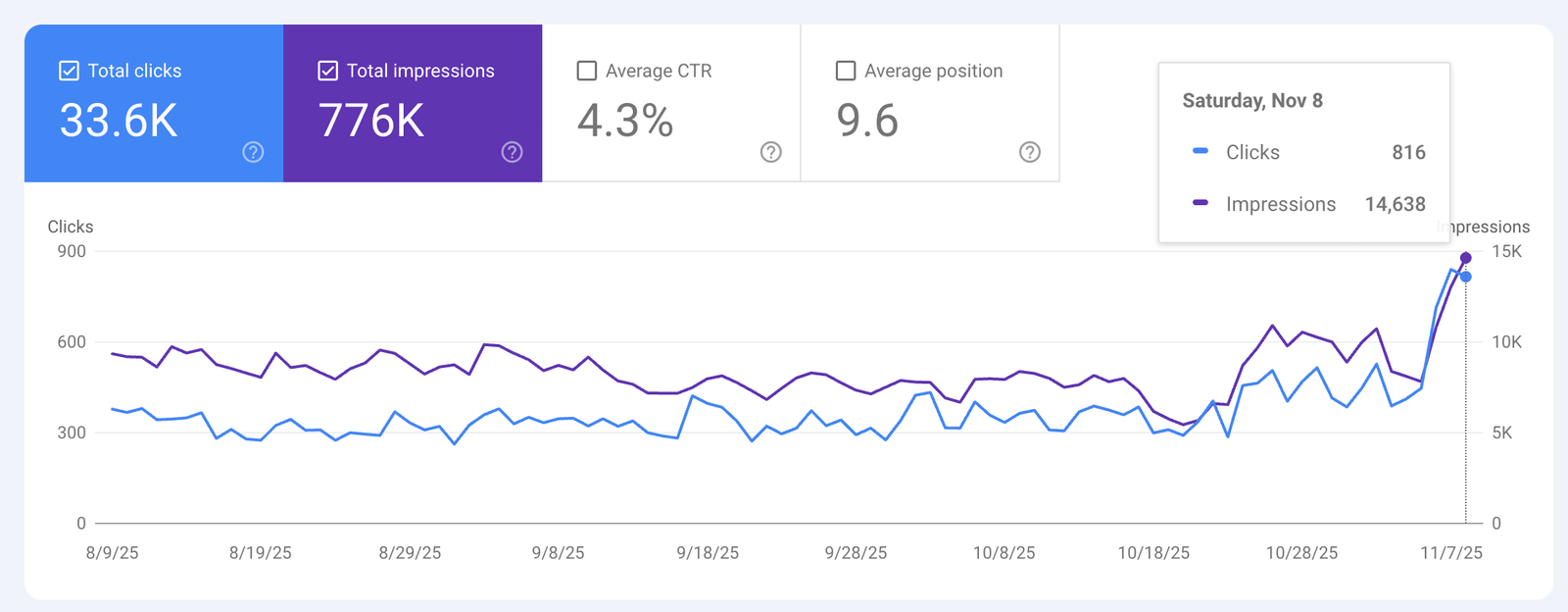
33.6K clicks and 776K impressions over three months, with average position at 9.6.
33.6K clicks · 776K impressions · 4.3% CTR · position 9.6
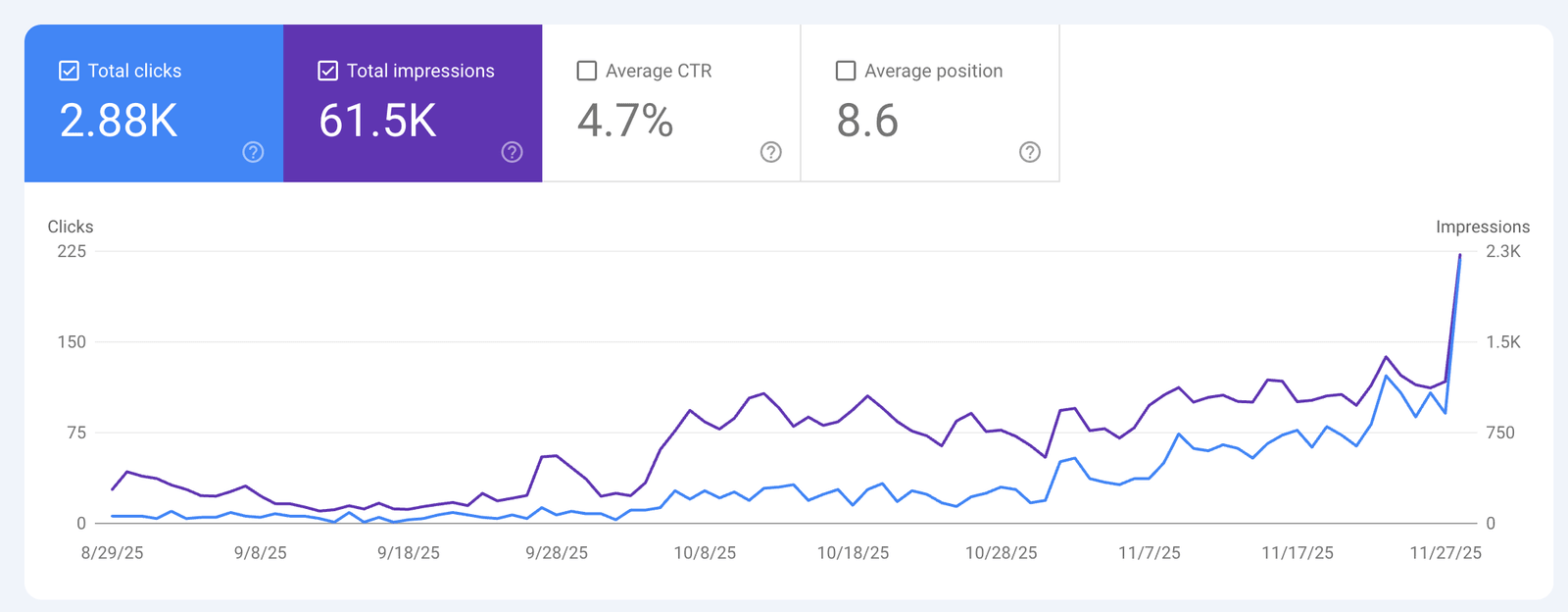
Clicks and impressions climbing steadily across a three month window, ending at 2.88K clicks and 61.5K impressions.
2.88K clicks · 61.5K impressions · 4.7% CTR · position 8.6
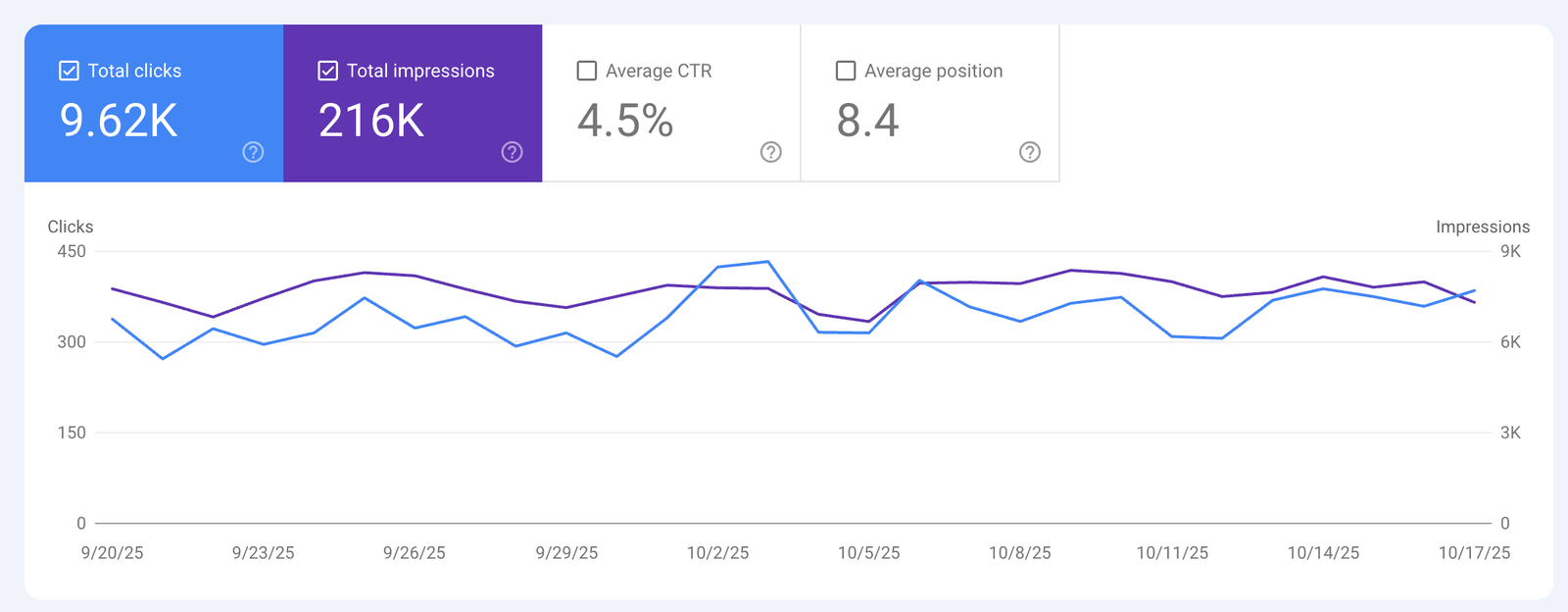
9.62K clicks and 216K impressions in a single 28 day period at 4.5% click-through.
9.62K clicks · 216K impressions · 4.5% CTR · position 8.4
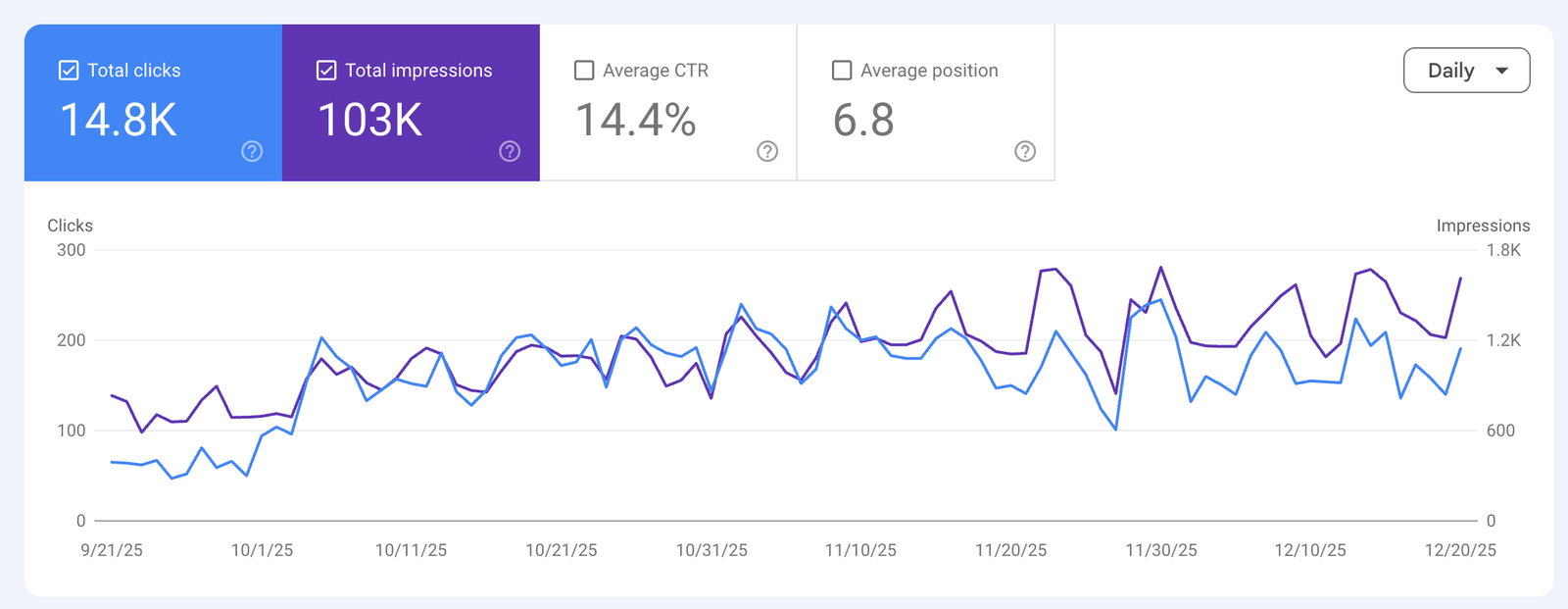
14.4% click-through rate at an average position of 6.8, well above the typical rate for that position.
14.8K clicks · 103K impressions · 14.4% CTR · position 6.8
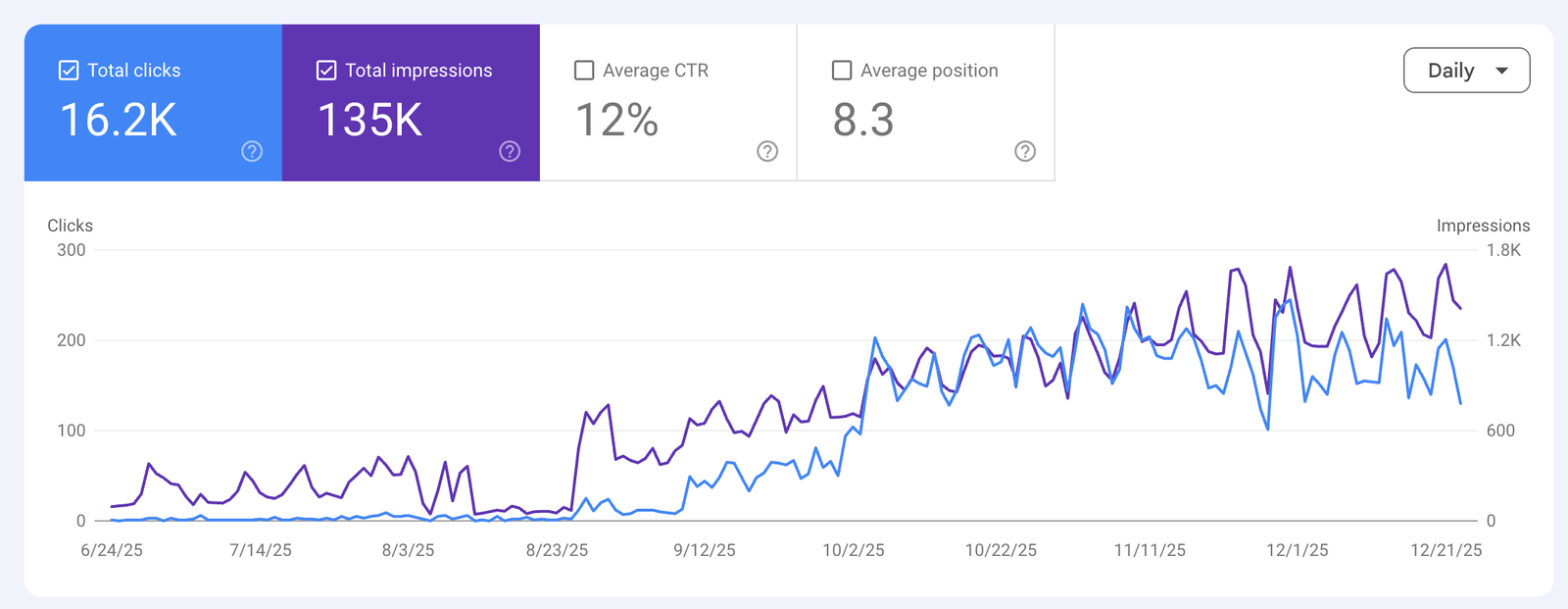
Six months of compounding growth to 16.2K clicks and 135K impressions at a 12% click-through rate.
16.2K clicks · 135K impressions · 12% CTR · position 8.3
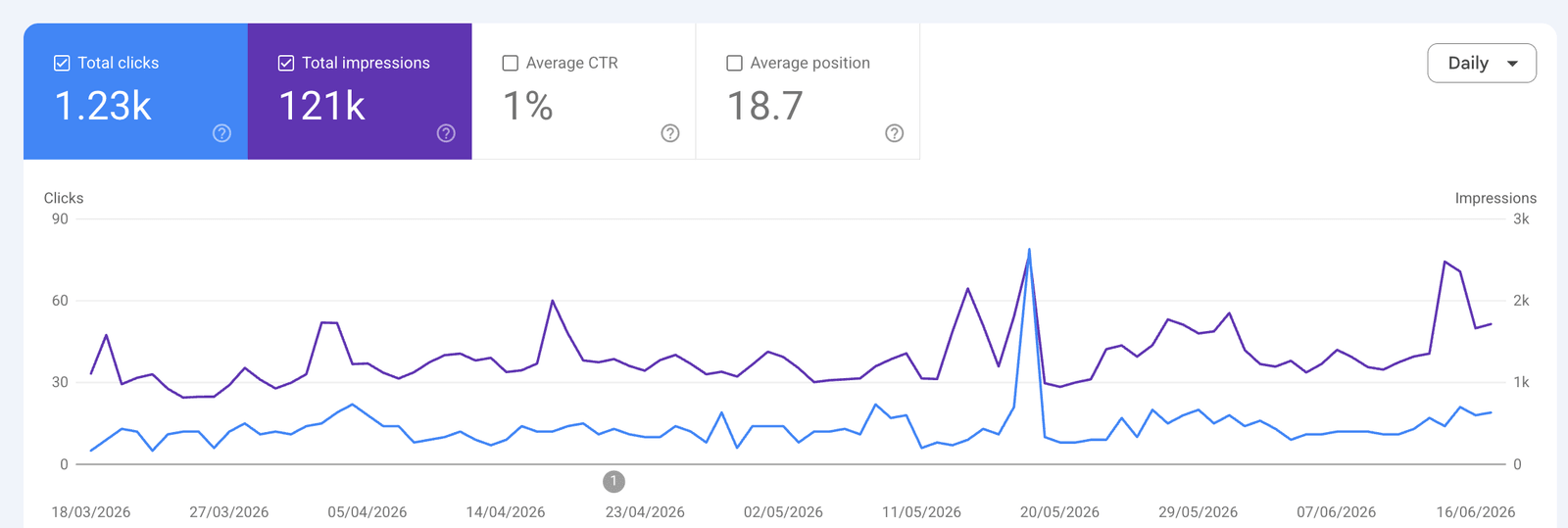
121K impressions over three months as new queries began returning the site.
1.23K clicks · 121K impressions · position 18.7
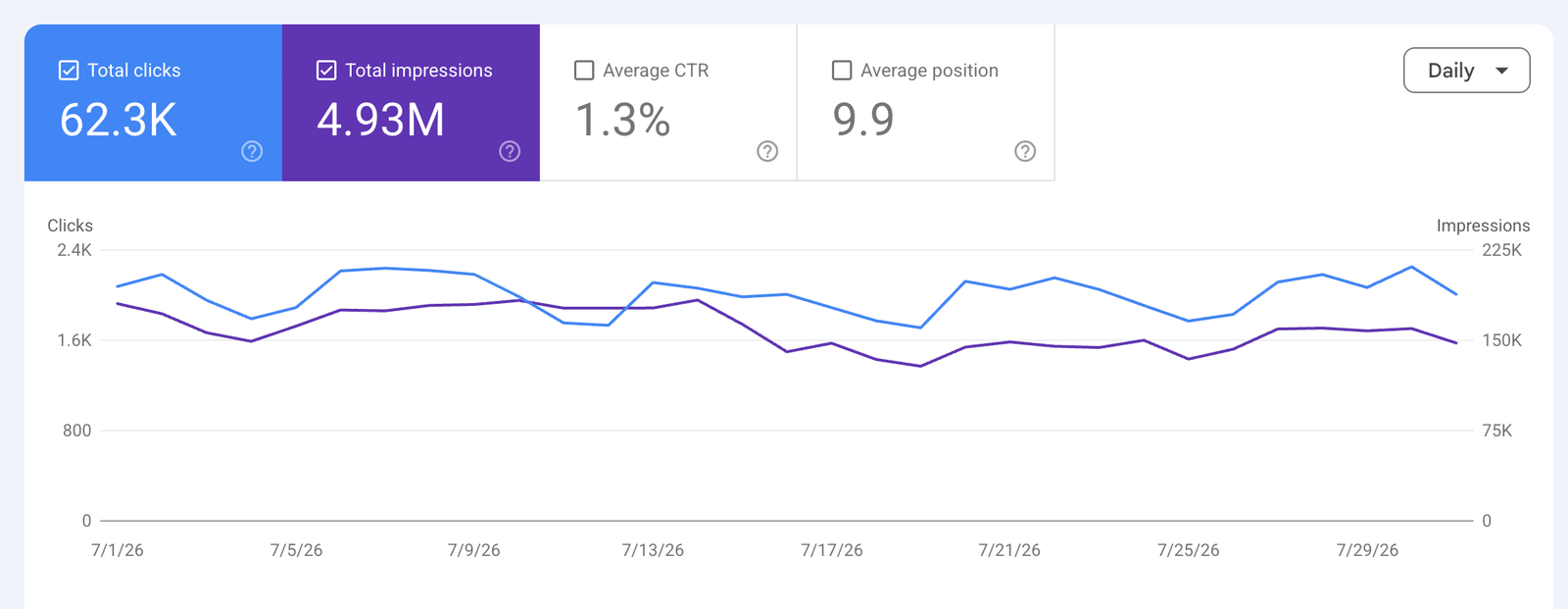
62.3K clicks from 4.93M impressions on a large catalogue.
62.3K clicks · 4.93M impressions · 1.3% CTR · position 9.9
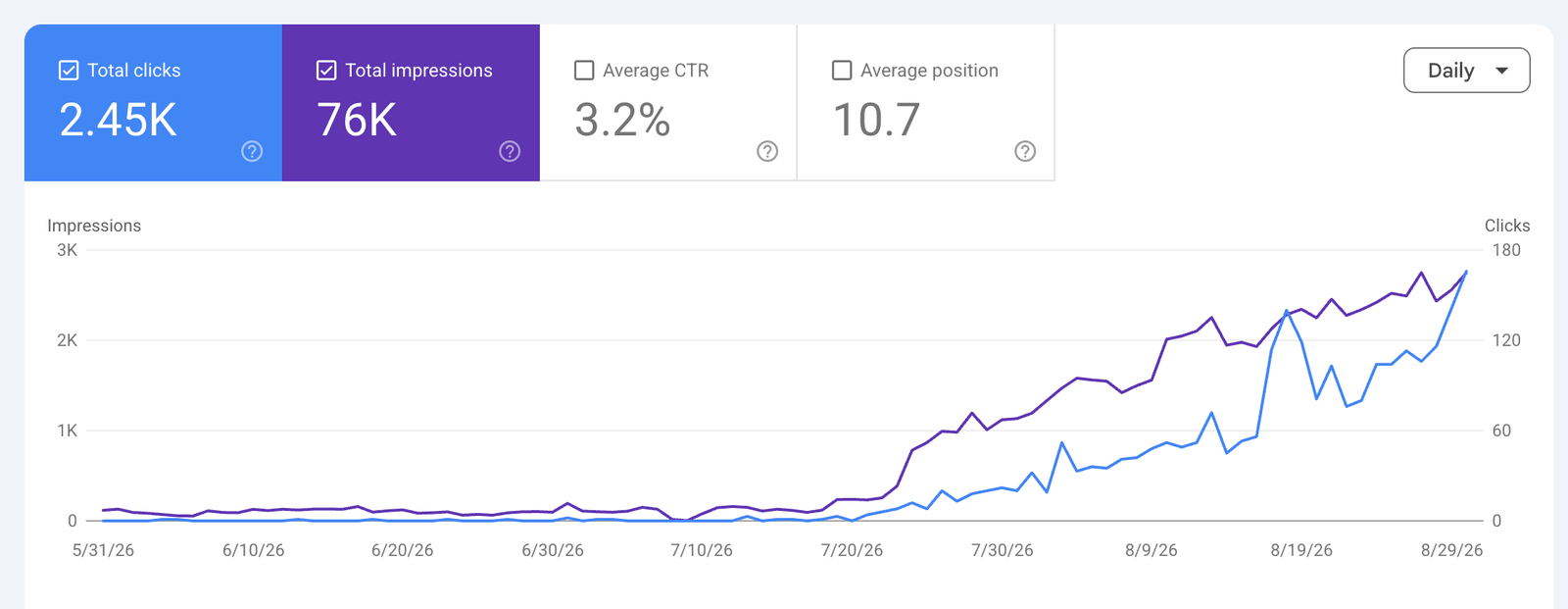
A flat baseline followed by sustained growth to 2.45K clicks and 76K impressions.
2.45K clicks · 76K impressions · 3.2% CTR · position 10.7
SEO performance varies by market, competition, website history and implementation. Examples shown are based on actual client data where indicated.
See what we find on yoursYou are hiring people who do Shopify SEO and AI search all day, not a general agency taking on a Shopify job. Here is exactly how the first ninety days run.
Days 1 to 5
We go through your store the way Google does, then send you a written list of what is stopping it and the three things we would fix first.
No call needed. Yours to keep if you go elsewhere.
Week 2 onward
We work inside your Shopify theme. Category pages, product copy, duplicate URLs, leftover app scripts. You watch it happen on your own site.
Every change logged. Live the day it ships.
Every 30 days
One report from your own Search Console. Rankings, traffic and orders. What moved, what did not, and what we are changing because of it.
If a month goes badly, you hear it from us before you ask.
We work with Shopify and Shopify Plus stores in Toronto, Vancouver, Calgary, Edmonton, Ottawa and Montreal. Each page below covers what is different about selling from there.
Also working with Shopify stores in Mississauga, Brampton, Hamilton, Victoria, Winnipeg, Halifax and Quebec City. Everything runs remotely, which is how ecommerce SEO works anyway.
The questions Shopify owners actually search for, answered straight. If yours is not here, ask it. You will get a real answer before there is any talk about money.
Talk to usSix to twelve months for meaningful movement, longer in competitive categories. Some things land much sooner: indexing fixes, product schema, and rewriting titles on pages that already get impressions can show in Search Console within weeks. Anyone giving you a date before seeing your store is guessing.
Usually one of five things. The store is too new, your pages are not indexed, your product copy is the supplier description twenty other stores also use, your collection pages have almost no text, or you are chasing keywords above your current authority. An audit tells you which.
Check four things in order: a recent redesign or migration with missing redirects, a change in Search Console indexing coverage, a Google update near that date, or simple seasonality. Technical causes often recover within weeks of being fixed. Authority problems take longer.
Yes, with known limits. Hosting, HTTPS, mobile rendering and sitemaps are handled well out of the box. The constraints are a fixed URL structure, duplicate product URLs through collections, limited robots.txt control, and apps that inject scripts. All workable once you know they exist.
Typically $1,500 to $6,000 a month depending on catalogue size, competition and how much implementation is included. Freelancers sit lower, large agencies higher. We do not publish packages, because a number quoted before seeing a store is either inflated or gets revised later.
Much of it, yes. Writing your own product descriptions, adding content to collection pages, fixing alt text and setting up Search Console are all within reach. Where people get stuck is diagnosing why Google ignores certain pages, cleaning up duplicate URLs, and editing Liquid safely.
Usually not. Most of what SEO apps do can be handled in your theme for free, and every app adds scripts that slow the store. Apps earn their place for bulk metadata on very large catalogues and redirect management during a migration. Little else.
Only when they support a product or collection page. Articles answering pre-purchase questions like sizing, materials or compatibility bring traffic that converts and give you somewhere to link from. Blogging for volume alone produces visitors who never reach a cart.
Open Search Console and check the Pages report. The usual causes are products excluded by a noindex setting, pages crawled but not indexed because the content is thin or duplicated, products buried too deep in the site structure, or a sitemap that omits them.
The platform decides what is possible. Shopify has a fixed URL structure, serves products at multiple addresses through collections, uses Liquid rather than plugins, and has an app ecosystem that creates URLs and injects code. Knowing those limits saves months of wasted effort.
Yes, and it is the core of the work. Collection pages are the biggest untapped opportunity on most stores, because category searches carry more volume than individual product searches and most collections ship as a bare grid. Product pages need to move past the supplier description.
Mostly size and delivery. A consultant is one expert who advises and hands specifications to your team. An agency or company covers technical, content and reporting, and usually implements as well. What matters more is whether they have worked on Shopify specifically.
Diagnose why Google is not sending your store traffic, then fix it. That means auditing crawling and indexing, rewriting collection and product pages, cleaning up duplicate URLs and redirects, researching what your buyers search, adding structured data, and reporting what each change did.
No, and neither can anyone else. Nobody controls Google, so a ranking guarantee is either a bet or a lie. We commit to improving the technical health, relevance and authority of your store, and reporting results from your own Search Console so you can see what the work returned.
Send us the store URL and the thing that frustrates you most. You get a written list of what is capping your organic revenue and what we would fix first.
Send us your Shopify store. We will tell you what is worth fixing first, based on your catalogue, your competitors and your market.
SEO performance varies by market, competition, website history and implementation. Examples shown are based on actual client data where indicated.